Supporting trans-disciplinary thinking through grantee networks
Each of us brings unique perspectives, routines, and resources to our problem-solving efforts. However, our individual viewpoints and capacities are always embedded in a larger context and influenced by the fields we are working in. To effectively address complex challenges, we must embrace this interconnectedness and look beyond silos—we need to upend our trans-disciplinary thinking capacities. Grantee networks with their wealth of expertise and connections can serve as platforms for fostering this approach.
 © Susanne Kitlinski
 The Bosch Alumni Network has long provided spaces for peer learning through a variety of events and opportunities. Yet, 2024 marked a significant moment in this ongoing development, as two juxtaposing approaches have been deliberately pursued:
- Bringing together heterogeneous groups to explore diverse contexts and fields, and to learn one specific method.
- Convening homogeneous groups to jointly gain insights from different fields.
The System Change Academy, held in November in Athens, Greece, and a workshop on Facilitating Transdisciplinary Research Group Meetings in Berlin, Germany, are examples of these approaches and showcase how embracing heterogeneity can unlock new capacities for trans-disciplinary learning and collaboration.
Systems Change Academy
Addressing complex challenges requires moving beyond isolated expertise as well as engaging with the interconnections between disciplines, sectors, and societal structures. Therefore, the Systems Change Academy supported a heterogeneous group of 25 professionals from 19 countries in jointly developing a systems-thinking mindset—one that embraces complexity, fosters transdisciplinary collaboration, and provides practical tools for navigating transformation.
Held in Athens in November 2024, the Academy combined conceptual learning with applied practice. Through exchanges with experienced systems thinkers and work on real-life cases, participants deepened their understanding of systemic properties such as interconnectedness, emergence, and “nestedness”. A core element of the program was recognizing patterns and narratives that either sustain or inhibit change, allowing participants to identify leverage points within their own professional contexts.
Beyond theoretical insights, the Academy emphasized personal and relational work. Through facilitated workshops and peer learning formats, participants strengthened their capacity to hold diverse viewpoints, integrate different approaches, and engage in reflective practice. They learned to see connections across complex challenges, to explore how change unfolds over time and at different levels, and to apply structured frameworks from the field of systems change to their own inquiries.
As part of an ongoing Academy series within the Bosch Alumni Network, the Systems Change Academy demonstrates how bringing together people with diverse experiences and perspectives to learn one specific method can provide fertile ground for trans-disciplinary thinking. Previous academies focused on topics such as Democracy (2023) and Governance (2022).
Facilitating Transdisciplinary Research Group Meetings
To respond to the needs of a rather homogeneous group—researchers working in Germany on sustainability topics—a workshop was organized, focusing on facilitation techniques for transdisciplinary research teams. The focus was on supporting participants in establishing facilitation skills and methods in their daily work that tap into diverse perspectives and collective intelligence—a trait that is not overly common in science and has the potential to significantly increase the effectivity and creativity of outcomes.
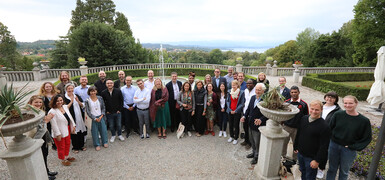
The initiative was started by a two-day workshop held in March 2024 near Berlin, where 25 participants established trust and a sense of belonging within the group while exploring the broader role of science in society and challenges of transdisciplinary collaboration in their field of work.
A follow-up workshop in October provided a more focused exploration of facilitation methods. The participants engaged in practical sessions on structuring meetings, moderating discussions, and fostering inclusive decision-making. Experiencing facilitation methods first-hand, they evaluated how these techniques—traditionally used in other fields—can strengthen collaboration in transdisciplinary research as well. By working within a homogeneous group, the participants were able to connect easily and to reflect on shared challenges.
The workshop created a new group of trust and support within the Bosch Alumni Network as well, that can help its members navigate challenges. Additionally, a workbook compiling the tools and skills explored during the sessions was also developed, receiving very positive feedback not only from the participants but from colleagues in the field as well.
The approach and setup of this workshop series underscores how insights from other disciplines can refine and strengthen collaboration within a specific professional community.
Diversity and heterogeneity as an asset in grantee networks
Heterogeneity, well facilitated, can be an asset in grantee networks that contributes to its overall impact and health. The approaches to creating learning spaces as tried out in the Bosch Alumni Network embrace heterogeneity from different angles. They require intentional structuring, thoughtful event design, and skilled facilitation to be effective. For Learning Facilitators, these formats offer valuable opportunities to apply different methodologies for leveraging the richness of diverse perspectives and for expanding participants’ thinking through exposure to unfamiliar contexts.
Our work is made possible thanks to the support and collaboration of so many colleagues and partners. It is a privilege to be connected to all of you through our shared ambitions and initiatives.
If we piqued your curiosity and you would like to find out more, please do not hesitate to get in touch with us!
This article has been taken from our Activity Report 2024. You can download the entire publication here: