
Glossary: Relational infrastructure in complex environments
Working in philanthropy means engaging with increasingly complex environments: challenges are interconnected, causality is difficult to trace, and outcomes cannot be fully controlled. In such contexts, the ability to act depends on how actors relate to one another—and how these relationships are intentionally supported through spaces, connectivity, and shared direction. We refer to this as relational infrastructure: the web of social connections, interactions, and intentional spaces for their facilitation that enables groups to collaborate effectively. This glossary offers a shared point of reference for the different forms of relational infrastructure used throughout our work.
 © Tina Kron
 Viewing social structures through the lens of relational infrastructure shifts the focus from static categories to the quality and dynamics of relationships that underpin them. It emphasizes trust, reciprocity, and shared meaning as core elements of impact-oriented work. This perspective entails several key shifts:
From structure to relationships
Instead of seeing structures such as organizations or networks as fixed categories, we acknowledge that they are constantly shaped by the quality of human connections.
From transactions to trust
Success is not measured by the number of partnerships or organizations involved, but by the depth of trust, reciprocity, and collective sense-making.
From coordination to emergence
Impact is not just about well-managed collaborations, but about how relationships enable emergence, adaptability, and system-wide change at systemic levels.
In complex environments, relational infrastructure acts as the connective tissue that enables actors to navigate uncertainty, leverage collective intelligence, and drive sustainable outcomes. Without it, even well-designed technical or institutional structures may fail to achieve their intended impact.
The following terms are frequently used in this context and are defined here to support a shared understanding across the articles that follow and in broader discussions.
Community
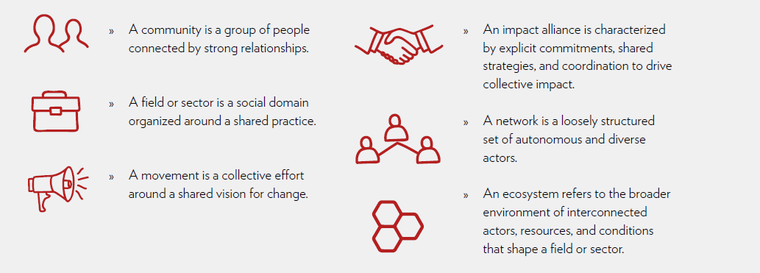
A community is a group of individuals connected by one or more of the following: shared values, shared interests, shared goals, a shared space, or a shared experience. Such connections may give rise to a sense of belonging, mutual support, trust, and ongoing interaction. Within impact-oriented networks, communities function as relational spaces that enable knowledge exchange, collaboration, and co-creation. In this context, they act as foundational components of larger collaborative structures.
Field / Sector
A field refers to a domain of social activity, knowledge, or practice shaped by norms, language, and institutions, which create a set of shared constraints for the actors within it. The term “sector” is often used interchangeably but more commonly applies to large categories such as the public, private, or nonprofit sectors.
Movement
A movement is a collective effort of individuals, groups, and organizations mobilizing around a shared vision for change. Unlike structured organizations, movements are decentralized and driven by shared narratives, values, and momentum. They rely on relational trust, storytelling, and grassroots engagement to influence systems and shift societal norms.
Impact Alliance
An impact alliance is a structured collaboration between multiple actors such as organizations, networks, funders, and community groups committed to achieving transformative social or environmental change. Unlike loose networks, an impact alliance is characterized by explicit commitments, shared strategies, and resource coordination to drive collective impact.
Network
A loosely structured set of autonomous and diverse actors (individuals or organizations) seeking to create social impact, formed around a specific shared purpose, experience, or space. Impact-oriented networks are characterized by their flexibility, ability to span boundaries, and focus on collective action. Networks function as relational infrastructures that facilitate cross-sectoral partnerships, accelerate learning, and foster collective agency beyond organizational silos.
Ecosystem
An ecosystem refers to the broader environment of interconnected actors, resources, and conditions that shape a field or sector. It includes organizations, networks, policies, funders, and cultural narratives that collectively enable or constrain impact. Ecosystem thinking emphasizes interdependence, adaptability, and systemic interventions rather than isolated projects or organizations.
This article has been taken from our Activity Report 2025.
You can download the entire publication here: