
Developing AI Literacy in times of accelerating change
With ongoing digitization across almost all sectors, new possibilities emerge, efficiency increases, and workflows develop that would have been unthinkable only a few years ago. Yet many of us also experience how efficiency gains often generate additional expectations and outputs rather than more time. This dynamic is often described as a rebound effect: when efficiency increases, overall activity can expand instead of contract. Could Artificial Intelligence (AI) cut through this dynamic? Could it create more space for relational and strategic practice—the kind of work we care about most? And can this be done in ways that are ethically sound and aligned with our values and principles?
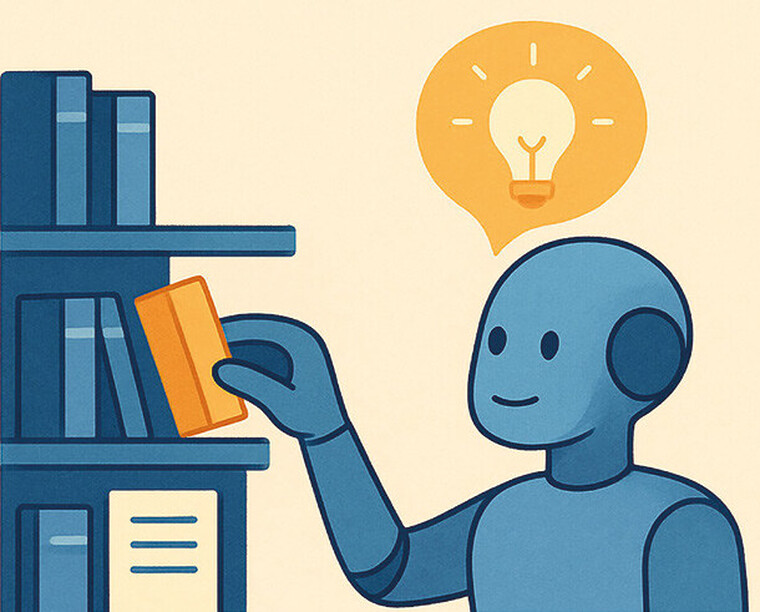 © ChatGPT
 Within only a few years, AI has moved from a niche technology to a force that many describe as creating a new industrial era. Its capabilities have not grown linearly but at a speed that continuously resets expectations about what is technically possible. Its most widely used tools, such as Large Language Models (LLMs), transcription and translation services, or image-generation systems, are no longer experimental add-ons; they are reshaping workflows, knowledge production, and expectations of productivity.
Such technological shifts deserve careful attention—not out of alarmism, but because transformations of this magnitude inevitably affect people, institutions, and social cohesion. AI challenges established practices while broadening access to knowledge, enabling more inclusive participation, and making services more responsive and accessible. Whether these potentials materialize depends on how deliberately and responsibly the technology is shaped in practice.
At the same time, this transformation confronts us with fundamental ethical questions. Concerns range from floods of unreliable or generic content to deepfakes; from its ecological footprint to the risk of reinforcing existent biases and power structures; from widening digital divides to new forms of digital dependency or even digital colonialism.
Institutions must ask how they are willing to adapt. At iac Berlin, we chose to approach AI proactively and treat it as an opportunity for organizational learning: What does it mean for a relational, network-oriented organization like ours to work with AI in ways that align with our mission, our culture, and our values? And what might we need to rethink or evolve to do so well?
From curiosity to capability
Our entry point into this question was a practical one. As AI tools became more capable, we noticed how quickly they could generate outputs and access to structured knowledge. We wanted to implement these capabilities with our own knowledge base while remaining compliant with our values as well as with GDPR regulations.
Exploring this path led us to experiment with a Retrieval-Augmented Generation (RAG) system in 2025. Instead of relying only on external tools, we wanted to understand how AI systems interact with organizational knowledge. Building and testing our own RAG allowed us to explore how AI can retrieve, structure, and interpret organizational knowledge while remaining transparent about sources and boundaries. The system now serves as an onboarding tool and central hub for accessing organizational knowledge and has continued to grow in both scope and use cases.
But the RAG system has always been a practical learning space, as well. Through it, we began to better understand how AI systems operate, where their strengths lie, and where their limitations and risks emerge. Understanding questions about prompting, hallucinations, bias, and data responsibility moved from abstract debates into everyday practice. As our general understanding grew, we documented our RAG development process and shared it in a handbook under a Creative Commons license so that other organizations could adapt the approach.
In parallel, we launched a peer-learning event series in our Community Space to invite exchange with other philanthropic and civic actors. These conversations helped situate our internal reflections within broader developments and enriched them with different practices and perspectives.
A positive pull-approach
To support such explorations, we had already established an internal working group on AI in 2024 and from there embedded the topic in cross-team conversations. The intention was to create orientation and tap into collective knowledge before accelerating our efforts. The working group became a space for exchange and for testing concrete applications, reflecting on ethical and legal implications, and distilling shareable learnings.
We learned that meaningful adoption requires curiosity and ownership within the team. A guiding principle throughout 2025 therefore became creating a positive pull rather than a compliance-driven push. Instead of calling on colleagues to use AI, we explored where AI could genuinely support our work and reduce friction in everyday processes.
For some colleagues, AI became a specialized expert for data structuring. For others, it functioned as an ideation partner, a sparring companion in analytical thinking or writing, or a structured feedback tool. These roles were not prescribed; they emerged through experimentation. What remained constant was that the human stays in the driver’s seat. AI can prepare, suggest, and synthesize. Decisions and accountability remain with us.
AI Literacy as cultural and organizational process
Through these experiments we learned that working with AI is not only a technical challenge but a literacy challenge as well. Understanding what AI systems can and cannot do, how they use data, where they introduce bias, and how their outputs should be interpreted requires shared competence across the organization. AI Literacy therefore means more than knowing how to use tools—it calls for the ability to integrate AI thoughtfully into everyday work.
Looking back, 2025 was about laying the foundations for this literacy. We invested in shared language, internal expertise, and governance that is clear enough to provide orientation yet flexible enough to enable continued learning. We started conversations about roles, mindset, culture, and implications.
Deepening these reflections and strengthening shared AI Literacy will remain a central theme in 2026. Our core intention will remain consistent: to use AI in ways that help us concentrate on what we do best as humans and colleagues—building relationships, exercising judgment, and creating spaces for meaningful exchange. We see this journey mirrored in many other organizations within the broader philanthropic context and look forward to continuing this path in exchange with the wider field.
If you want to know more about strategy in complexity, please do not hesitate to get in touch with:
Tobias Gerber
tobias.gerber@iac-berlin.org
This article has been taken from our Activity Report 2025.
You can download the entire publication here: