Reimagining Resilient Resourcing
In today’s global climate of shrinking resources for civic action, the question of how it sustains itself has become urgent. This pressure is felt across civil society, where resourcing has taken on a different weight: in many contexts, the issue is no longer how to grow, scale, or innovate, but how to survive in times of scarcity. Funding cuts, geopolitical re-alignments, and mounting political pressure are eroding the conditions that once enabled independent initiatives to thrive, leaving established support structures increasingly fragile.
This shift exposes how narrowly resources have come to be defined, often equated primarily with financial support. When resourcing is reduced to monetary flows, the broader energies, relationships, and conditions that sustain civic ecosystems begin to fade. What has been built over time risks disappearing—not for lack of purpose, but for lack of the means to endure.
 © Farah Makki
 One concrete space where these concerns were explored was a gathering in Egypt in 2025, during the “Culture in the Civic Space in the MENA Region” Learning Journey for Field Supporters. Twelve organizations together with voices from the funding landscape engaged with the question of reimagining resilient resourcing, starting from reflections such as: What keeps civic work alive when money becomes scarce or unavailable? What forms of alternative resourcing already exist beyond formal funding, and how resilient are they?
In the learning journey, resourcing has never been treated as a side topic. A shared observation was that, as traditional funding became increasingly unreliable over recent years, participating organizations have started to adapt, improvise, redistribute, lean on relationships, and build small structures that keep their practice alive. These moves are often fragile, sometimes invisible, and rarely named as “resourcing”—yet they are what makes the continuation of action for justice and free civic space possible. The question therefore shifted to: what helps a field endure, and what kinds of support strengthen shared conditions for a resilient ecosystem rather than isolated actors?
Reading the landscape together
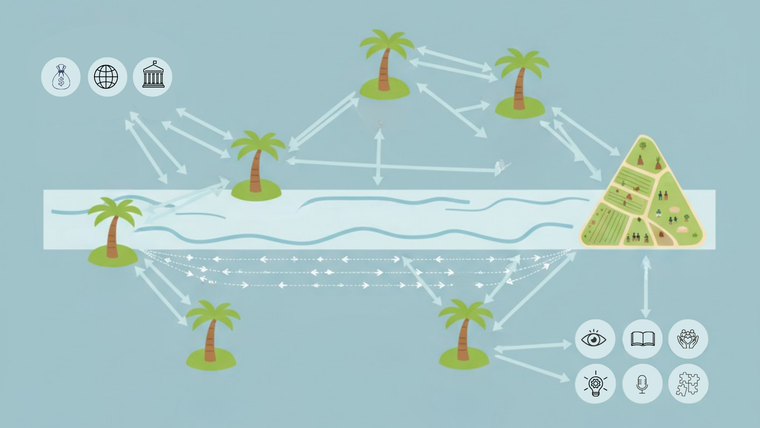
When the group met in Egypt, the setting offered more than a meeting location. It offered a contextual metaphor that matched the conversation: the Nile. The river is, in a sense, a Field Supporter itself, sustaining the conditions for life across eleven countries. Thinking with the Nile in mind made it easier to talk about resourcing as a system: sources and flows, visible streams and underground waters, channels that distribute, and places where fertility depends on how water is held, moved, and shared.
The purpose of the workshop was practical. The group worked together on one core question: if we may soon be navigating a landscape where traditional funding is absent or severely reduced, how can alternative ways of resourcing become resilient enough to keep energies in civic sphere and spaces of action alive?
Working with archetypes
The Nile as metaphor helped articulate five resourcing archetypes. These did not appear as abstract models—they emerged from observing the practices and experiments organizations are already putting in place to keep going.
1. Oasis and underground waters
Self-regenerating spaces and hidden buffers that help work continue when formal funding recedes: These include small internal economies, community contributions, earned income, and informal support systems such as mutual aid, exchanges, or reserves built in better times.
2. Nomads and transhumance
Adaptability through (digital) movement: People and organizations carry skills, relationships, and credibility across contexts. Mobility becomes a way to keep the work going when fixed infrastructure becomes risky, unaffordable, or constrained.
3. Delta and irrigation channels
Strategic micro-distribution: Instead of large, centralized pipelines, these practices create smaller, intentional routes that help resources reach grassroot actors directly, with less loss, less delay, and more local control.
4. Harbor, port, flotilla
Connection points where global solidarity networks meet local needs: docking stations mobilize diaspora ties, international alliances, and crowd-based support. They bring in resources, attention, and protection but work best when aligned with local priorities and accountability.
5. Spring and river systems
Alternative longer-term source and redistribution mechanisms: Community-controlled funds, trust-like structures, endowments, or other arrangements aim for continuity in a specific field rather than one-off projects. They are difficult to build, but they change what becomes possible when they exist.
Working with these archetypes helped to shift the conversation from “which strategy is best?” to “what aspect needs strengthening?” to make resourcing more resilient. The workshop included classic analytical elements such as understanding the strengths, weaknesses, opportunities, and risks of each archetype, before moving into reflection on resilience strategies. One of the most important outcomes, however, was a question to carry forward: what becomes possible if we move beyond the idea that resourcing is only financial?
This matters because funding cuts are not only a budget issue. They risk the disappearance of people, knowledge, and infrastructures that have stewarded civic space for a long time. If resourcing remains framed mainly as financial access, then every cut pushes the system closer to exhaustion. If resourcing is understood more granularly as the ability to sustain conditions for purpose, other forms of support become visible and actionable: relationships, space, care, trust, mobility, distribution capacity, legitimacy, and time.
Take-aways for practitioners and philanthropy
For practitioners in arts, culture, and civil society, the archetypes can serve to map resourcing systems beyond grants and project funding. Looking at “underground waters” makes hidden buffers and informal support visible. Attention to “channels” and “deltas” helps identify where resources get blocked or lost, and where small adjustments could make flows more reliable. Resilience appears less as an individual survival strategy and more as collective infrastructure: alliances, shared spaces, and collective practices that allow work to continue even when conditions tighten. The archetypes also function as prompts for experimentation for example by strengthening one buffer, testing a new micro-distribution channel or flotilla-based form, or investing in mobility as a form of continuity.
For philanthropy and other resource providers, the framework points to areas where support can increase resilience rather than dependency. When funding is still available, investing in spaces for learning, imagination, and planning becomes a form of preparedness rather than an optional extra. Supporting relationship-building, distribution infrastructure, community-owned spaces, and governance mechanisms that enable redistribution helps stabilize ecosystems before crisis deepens. Shifting attention from short-term outputs to indicators of endurance, such as reduced fragility, diversified flows, and strengthened field-level capacity, can help align support with the long-term survival of civic space.
Reimagining resilient resourcing is not about replacing one funding model with another. It is about widening what counts as a resource, noticing what already sustains life in the system, and strengthening it while keeping an eye on the horizon we do not want to lose.
Special thanks go to Farah Makki for her contribution to this text.
If you want to know more about strategy in complexity, please do not hesitate to get in touch with:
Mohab Saber
mohab.saber@iac-berlin.org
This article has been taken from our Activity Report 2025.
You can download the entire publication here: